
Etsy is a great place to get discovered – but it’s a terrible place to build a business you actually own. Every sale you make there, Etsy keeps a cut, controls the customer relationship, and can change the rules overnight. If you’ve ever thought “there has to be a way to keep more of my own money,” there is, and it’s more beginner-friendly in 2026 than it’s ever been.
The direct answer: to sell digital products without Etsy, you set up a simple funnel – a landing page, a checkout that delivers your file automatically, and an email list to capture buyers – using an all-in-one tool like Systeme.io instead of a marketplace. You drive traffic from Pinterest, YouTube or your email list straight to your own checkout, so there’s no marketplace fee and you own the customer. You don’t even need a full website to start.
Here’s the money math that makes this worth it. On Etsy in 2026 you’re paying a $0.20 listing fee, a 6.5% transaction fee, and a 3% + $0.25 payment processing fee – roughly 12-15% of every sale before you touch Etsy Ads, which can push your total cut past 20-30%. Sell the same product from your own funnel and you’re paying only the payment processor (around 3%). On a $20 product that’s the difference between keeping about $16 and keeping about $19 – every single sale.

Do You Need a Website to Sell Digital Products Without Etsy?
No. You can sell a digital product with nothing more than a checkout link, a social post, and a few hundred engaged followers. The idea that you need a full website first is the single biggest thing that keeps beginners stuck on Etsy.
What you actually need is three pieces: a page that describes the product, a checkout that takes payment and delivers the file, and a way to collect the buyer’s email. An all-in-one platform like Systeme.io (https://earnwithdesign.com/systeme) bundles all three on its free plan, so you can point a link straight to a checkout without building or paying for a site.
The creator economy crossed $250 billion in value in 2024, and a growing share of that is creators selling directly instead of through marketplaces – precisely because the margins and the ownership are so much better.
What Is a Sales Funnel for Digital Products?
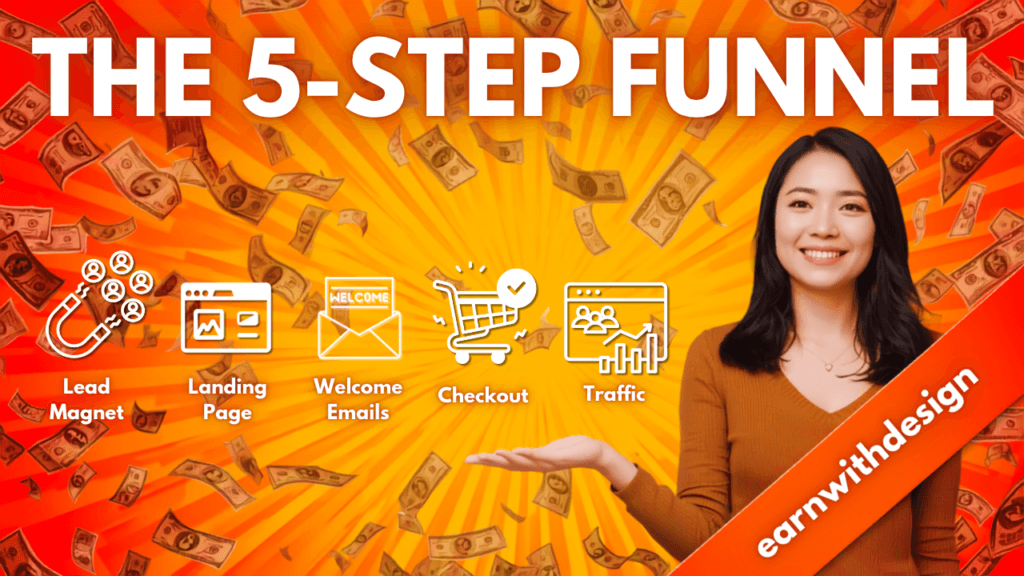
A sales funnel is just the path a stranger takes from “who are you” to “I bought it.” For a digital product it usually has three steps: a free lead magnet that gets the email, a welcome sequence that builds trust, and an offer for your paid product.
Keep it short on purpose. Every additional click in a funnel kills roughly 5-15% of your conversions, so the fewer steps between “interested” and “paid,” the more you sell. A beginner funnel doesn’t need to be clever – it needs to be short.
The Simplest Funnel That Works
Here’s the whole thing, start to finish:
- Lead magnet – a free sample (one planner page, a mini template) that gets someone onto your list
- Landing page – a single page offering the freebie in exchange for an email
- Welcome emails – 3-5 automated emails that deliver the freebie, tell your story, and introduce your paid product
- Checkout – a page that takes payment and auto-delivers the file
- Traffic – Pinterest, YouTube, or your existing email list pointing at the top of the funnel
That’s it. No blog required, no 20-page website, no ads.

How Do You Set Up a Funnel Without Etsy Step by Step?
Pick one all-in-one tool, build a landing page, connect a checkout, and automate a welcome email. Here’s the beginner path.
Step 1 – Pick One All-in-One Tool
The mistake beginners make is stitching together five free tools that don’t talk to each other. Instead, use one platform that does landing pages, email, and checkout together. Systeme.io (https://earnwithdesign.com/systeme) is the one I point beginners to because the free plan covers email, a sales funnel, and unlimited emails to your first contacts – enough to make real sales before you pay anything.
If you want higher-converting, quiz-style or interactive opt-in pages specifically, LeadCreator (https://earnwithdesign.com/leadcreator) is built for that and gets you a lead-capture page live in under an hour.
Step 2 – Build Your Landing Page
Create one clean landing page offering your lead magnet. Headline that names the outcome, a line or two on what they get, one button, one form field (email). Don’t add a menu, don’t add links out – a landing page has exactly one job, which is to get the email.
Step 3 – Connect a Checkout for the Paid Product
Set up a checkout page for your actual product. Upload the file so it delivers automatically the moment payment clears – this is what makes it truly passive. Connect your payment processor (Stripe or PayPal), and you’re taking money without a marketplace in the middle.
Step 4 – Automate a Welcome Sequence
Write 3-5 emails that trigger automatically when someone joins: deliver the freebie, share why you make what you make, give one genuinely useful tip, then invite them to buy. I break down exactly what each email should say in my welcome sequence post linked at the bottom.
Step 5 – Send Traffic to the Top
Now point people at the free offer. Pin the landing page on Pinterest, link it in your YouTube descriptions, and mention it in your content. A short demo clip works great here – I make mine in CapCut (https://earnwithdesign.com/capcut) by screen-recording the product and adding one caption.
Should You Quit Etsy Completely?
No – and this is the part most “leave Etsy” advice gets wrong. The smartest setup in 2026 is to use Etsy for what it’s good at (92 million-plus active buyers browsing with their wallets out) while funneling those buyers onto your own list so you own the relationship going forward.
Put a “get a free bonus” insert in your Etsy digital downloads that points to your landing page. Every Etsy buyer becomes an email subscriber you can sell to directly, fee-free, forever. Etsy becomes your discovery engine, and your funnel becomes your actual business.
Here’s my channel where I walk through building these funnels on camera:
https://www.youtube.com/@RachelYeong
Grab My Free Resource
Want a repeatable weekly system for planning the content that feeds your funnel instead of posting at random? Grab my free 30-Day Action Content Planner for Canva: https://earnwithdesign.com/30-day-action-content-planner-canva/
You can also grab my free funnel starter checklist over at https://lead.earnwithdesign.com to map your first funnel in an afternoon.
FAQ
Can I sell digital products without Etsy or a website? Yes. With an all-in-one tool like Systeme.io you can sell using just a landing page and a checkout link – no full website needed. You share the link on Pinterest, YouTube or email and the file delivers automatically after payment.
What is the best platform to sell digital products off Etsy? For beginners, an all-in-one platform that combines landing pages, email and checkout is easier than juggling separate tools. Systeme.io has a free plan that covers all three, which is why it’s a common first choice before scaling up.
How much do I save by not selling on Etsy? Etsy takes roughly 12-15% per sale in mandatory fees before ads, which can climb past 20-30% with Etsy Ads. Selling from your own funnel, you typically pay only the ~3% payment processing fee, so on a $20 product you keep around $19 instead of about $16.
Do I have to quit Etsy to sell on my own? No. Most successful sellers keep Etsy for discovery and use it to feed buyers onto their own email list. That way you get Etsy’s traffic and your own fee-free repeat sales at the same time.
How long does it take to set up a funnel? A basic funnel – one landing page, one checkout, and a short welcome sequence – can be built in a weekend if your product is already made. The email automation is the part worth spending real time on, since it runs on its own afterward.